
What heat has to do
Every cooking method is a way of moving heat from a source, such as a gas flame, an electric element or a microwave oven's generator, into food. The method you pick decides how fast that heat arrives, whether it arrives through metal, air, water or fat, and how hot the surface of the food can get. Those three things explain most of what happens in a kitchen: why a steak browns in a pan but turns grey in a pot of water, why a thick roast is still cool in the middle when the outside looks done, and why stirring a microwaved dish matters.
Physics textbooks describe three ways heat travels: conduction, convection and radiation. Real cooking nearly always mixes them. A pan on a burner is heated by the flame, passes heat into the food by contact, and also warms the air above it. It still helps to take them one at a time, because each one has its own strengths and its own limits.
Conduction: heat by contact
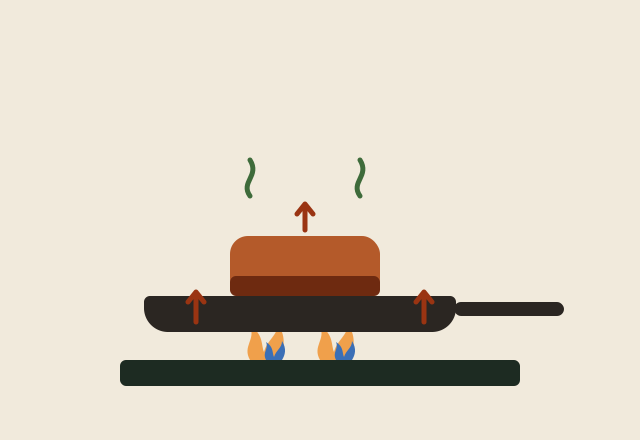
Conduction is heat passing from one thing to another where they touch, and through a solid from its hot side to its cold side. When you lay a piece of chicken in a hot pan, the metal passes heat straight into the surface it touches. That is why a good sear needs full contact: a piece that only touches the pan at one corner browns only at that corner.
Conduction also carries heat inside the food itself. Food is a fairly poor conductor, so heat moves inward slowly. The USDA Food Safety and Inspection Service (FSIS) makes this point when it explains microwave cooking: in a thick piece of food, the energy does not reach the centre, and that centre cooks by conduction of heat from the outer areas inward. The same is true in an oven, a pan or a pot. Whatever the method, the middle of a thick piece of food is always the last part to heat up.
Convection: hot air and hot water
Convection is heat carried by a moving fluid, which in a kitchen means air, water, steam or oil. FSIS describes a conventional oven as one where food is heated by hot air. The air touches every exposed surface of the food at once, which is why roasting cooks a chicken all over rather than only on the side touching the tray.
Water in a pot works the same way, but with one important difference: liquid water has a ceiling. FSIS notes that at sea level water boils at 212°F (100°C), and that no matter how high you turn the burner, water cannot get hotter than its own boiling point unless you use a pressure cooker. Turning up the heat under a pot that is already boiling only makes the water boil away faster. Higher up, the boiling point is lower, so food cooked in boiling or simmering water takes longer at altitude. The moist-heat guide returns to this ceiling, because it shapes everything water-based cooking can and cannot do.
Hot oil is also a convection medium, but it is not held at the boiling point of water the way a pot of water is. The FDA groups frying with roasting and baking as high-temperature cooking, and that difference is why frying can brown food while boiling cannot.
Radiant heat and microwaves
Radiant heat travels as energy that does not need to touch the food or warm the air on the way. The glowing element of an oven's broiler is the everyday example. The Iowa State University food preparation lab manual describes broiling as cooking food a measured distance below direct, dry heat, and its glossary tells cooks to measure that distance from the surface of the food, not from the rack. The distance matters because radiant heat weakens quickly as the food moves away from the source.
A microwave oven is a special case. FSIS explains that microwaves are absorbed by the water, fat and sugar in food and make those molecules vibrate very fast, and that vibration produces the heat that cooks. The microwaves only reach a short way into the food; deeper parts cook by conduction, as above. Because the air inside a microwave oven stays at room temperature, the surface of the food stays cooler than it would in a conventional oven, so, as FSIS puts it, microwaved food does not normally become brown and crispy. Microwaves can also heat unevenly and leave cold spots, which is why FSIS advises stirring or turning food partway through and checking the temperature in several places.
Why the outside cooks first
Put the pieces together and one pattern runs through every method. The surface of the food meets the heat first, and the centre heats more slowly, by conduction from the outside in. The thicker the food, the bigger the gap between how done the outside is and how done the middle is.
Cooks manage that gap in a few ways: cutting food into smaller, even pieces, lowering the heat so the outside does not overcook before the middle catches up, or starting with high heat for colour and then finishing more gently. The one thing that tells you what is happening in the middle is a food thermometer. FSIS advises placing it in the thickest part of the food, which is the part that heats last. The safe temperatures page lists the readings to look for.
Browning and the Maillard reaction
The brown crust on a seared steak, toast or a roasted potato is not burning, and it is not just drying. Much of it comes from a family of chemical reactions known as the Maillard reaction. The US National Library of Medicine's subject vocabulary defines the Maillard reaction as a group of non-enzymatic reactions in which reducing sugars, among other compounds, react with the amino groups found in amino acids and proteins, and it notes that food browning during high-heat cooking such as grilling, frying and roasting is attributed to it. These reactions create both the brown colour and much of the savoury, roasted flavour people associate with cooked food.
The key words are high heat. The FDA, explaining how a related compound called acrylamide forms, says it forms from sugars and an amino acid naturally present in food during high-temperature cooking such as frying, roasting and baking, and that boiling and steaming do not typically form it. In other words, the sugar and amino acid reactions behind browning belong to dry heat. Water-based methods cannot reach those surface temperatures, because water stays at or below its boiling point. While the surface of a piece of food is wet, the water on it holds the surface back; once that water has gone, the surface can get hot enough to brown.
That gives three practical habits, each of which follows from the sources above:
- Start with a dry surface. Patting meat or vegetables dry lets the surface get past the water stage sooner.
- Use dry heat for colour. A hot pan with a little fat, a hot oven or a broiler can brown food. A pot of simmering liquid or a steamer cannot, so braises usually brown the meat first and add liquid afterwards.
- Leave room. Pieces packed tightly together trap their own moisture. Spreading food in a single layer, as university extension guidance on roasting vegetables suggests, gives each surface a chance to dry and brown.
Browning has a trade-off worth knowing about. The FDA's interest in acrylamide is that it forms in some foods, mainly plant foods such as potatoes and grains, during the same high-temperature cooking. This guide does not give advice on how dark to cook food; the FDA's own questions and answers page is the place to read its current guidance.
This guide also does not give a temperature at which browning starts. Cooking books quote several different figures, and none of them comes from the food-safety agencies this site takes its numbers from. What matters in practice is visible: a dry surface, a hot pan or oven, and colour that develops over a few minutes.
Caramelizing is a different thing
"Caramelized" is often used loosely for anything brown and sweet. Strictly, caramelizing is what happens to sugar itself when it is heated until it melts and turns from clear to golden and then dark brown. The Iowa State glossary defines it that way and adds that fruits and vegetables with natural sugars can be caramelized by sautéing, roasting or grilling, which gives them a sweet flavour and a golden glaze.
Example: one potato, three ways
Worked example
This is an illustration of the principles above, not a recipe, and it describes no real kitchen. A cook cuts one potato into even pieces and cooks a third of them each way.
- Boiled. The pieces sit in water that cannot rise above its boiling point. They cook through by convection from the water and conduction inward. They turn soft and pale, with no brown crust, because the surface never dries.
- Roasted. Tossed in a little oil and spread in one layer on a tray in a hot oven, the pieces are surrounded by hot air. Their surfaces dry, then brown, while the insides soften more slowly.
- Microwaved. In a covered dish, the pieces heat quickly from the energy absorbed by their water, but the air around them stays cool, so they steam rather than brown. The cook stirs halfway so that no cold spots are left.
Same potato, same size of piece, three different results. The difference is not the ingredient but the way the heat arrives and how hot the surface is allowed to get. The next two guides look at each family of methods in turn, starting with dry heat.
Up next on the range: Dry-heat methods: sauté, roast, broil and pan-fry