
Why knife skills matter
Good knife work is not about speed. It does two practical jobs. It keeps your fingers safe, and it produces pieces of an even size, which is what makes food cook evenly. Mississippi State University Extension makes the second point in its roasting instructions for vegetables: cut them into cubes and try to keep them all about the same size. A tray of mixed sizes leaves some pieces burnt and others still hard.
For safety, this guide draws on the Occupational Safety and Health Administration (OSHA), whose guidance for young restaurant workers sets out how to use, carry and store knives. It is written for professional kitchens, but the habits it describes are just as sensible at home.
The cutting board
A board that slides around is a hazard, so set it on a flat, dry surface where it does not move before you start. The board itself is also a food-safety tool. The USDA Food Safety and Inspection Service (FSIS) says home cooks can use wood or a nonporous board such as plastic, marble or glass, and that nonporous surfaces are easier to clean.
FSIS suggests keeping one board for fresh produce and bread and a separate one for raw meat, poultry and seafood, so that bacteria from raw meat cannot reach food that will not be cooked. It advises washing every board in hot, soapy water after each use, then rinsing and drying it, and throwing a board away once it is badly worn or has grooves that are hard to clean. The kitchen food safety guide explains why keeping raw and ready-to-eat food apart matters so much.
The guiding hand
OSHA's first rule for cutting is to keep your fingers and thumbs out of the line of the cut. In practice that is the job of the hand that is not holding the knife.
- Hold the food steady. Food that rolls is food that slips. Cut a thin slice off a round vegetable to make a flat side, then lay it on that side.
- Curl the fingertips under. Rest the fingertips on the food with the tips tucked back, so that the knuckles, not the fingertips, face the blade. The flat of the blade can rest lightly against the knuckles as a guide, and the fingertips stay out of the cutting line.
- Move the hand back, not the blade forward. After each slice, walk the guiding hand back a little and cut again.
- Cut away from your body. OSHA says to cut in the direction away from the body, never toward it.
- Use the right knife for the job. OSHA advises using a knife only for its intended purpose and choosing the knife that suits the task. A knife is not a can opener or a screwdriver.
The named cuts
Recipes use a short vocabulary for how to cut food. The Iowa State University food preparation lab manual's glossary defines the common terms:
| Term | What it means |
|---|---|
| Chop | Cut into bite-size pieces with a knife. Chopped food is coarser than minced food, and the pieces need not be exact. |
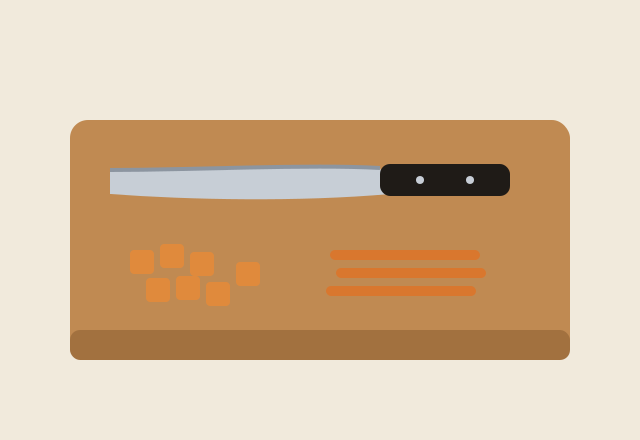
| Dice | Cut into small cubes, about an eighth to a quarter of an inch on each side. |
| Mince | Cut into very tiny pieces, finer than diced. |
| Julienne | Cut into thin sticks: first into even slices, then the slices into strips. |
Most cuts are built the same way: make even slices, stack or lay the slices flat and cut them into even strips, then turn the strips and cut across them. Stop at strips for a julienne; cut across for a dice; keep going finer for a mince. The more even the first slices, the more even everything after them.
Handling, carrying and storing knives
Knife safety does not stop when the cutting does. OSHA's guidance covers the moments around the cut:
- Let a falling knife fall. Do not try to catch it. Step back and pick it up once it has landed.
- Carry it pointed down. Hold a knife at your side with the tip pointing down and the edge angled slightly away from your body.
- Do not hand it over. Put the knife down on a clean surface and let the other person pick it up.
- Never leave it in the sink. A blade hidden under soapy water is a cut waiting to happen. Clean a knife straight after use, or put it somewhere set aside for knives only.
- Store blades covered. Keep knives in a set place, not loose in a drawer with the edge exposed, and do not leave them near the edge of the counter.
- Stop when interrupted. If someone talks to you, stop cutting and put the knife down. Do not cut while distracted.
Stovetop and fire safety
The US Fire Administration says cooking is by far the leading cause of home fires and home fire injuries, and it points to unattended cooking as a leading factor. Its advice for home cooks is short:
- Stand by your pan. If you leave the kitchen, turn the burner off.
- Watch the heat. Fires start when the heat is too high. If you see smoke or the grease starts to boil, turn the burner off.
- Turn handles in. Point pot and pan handles toward the back of the stove, so nobody can bump them or pull a pan over.
- Keep a lid close. Keep a pan lid or a baking sheet nearby. If a pan catches fire, slide it over the pan to put the fire out, and turn the burner off.
Steam and hot handles
Burns in the kitchen come as much from steam and hot metal as from flames. Mississippi State University Extension warns, in its instructions for steaming and microwaving vegetables, that the steam released when a lid comes off can burn. Lift a lid so that it opens away from you and the steam escapes on the far side. Treat every pan handle that has been on or in the oven as hot until you have checked it,, and keep oven gloves or a thick, dry cloth to hand.
Example: dicing an onion safely
Worked example
An illustration of the habits above; it describes no real kitchen.
- The cook sets the board on a dry counter and checks it does not slide.
- They cut the onion in half from top to root, peel it, and lay each half flat side down so it cannot roll.
- With fingertips curled and knuckles toward the blade, they make even slices in one direction, leaving the root end uncut so the layers hold together.
- They turn the half and cut across the slices, walking the guiding hand back after each cut, to make small, even dice.
- When someone calls from the next room, they put the knife down flat, away from the counter edge, before turning round.
- When they finish, they wash and dry the knife and put it away instead of dropping it in the sink.
Even pieces and ten intact fingers come from the same habits. The next guide covers the other half of preparation: measuring.
Up next on the range: Measuring and following a recipe